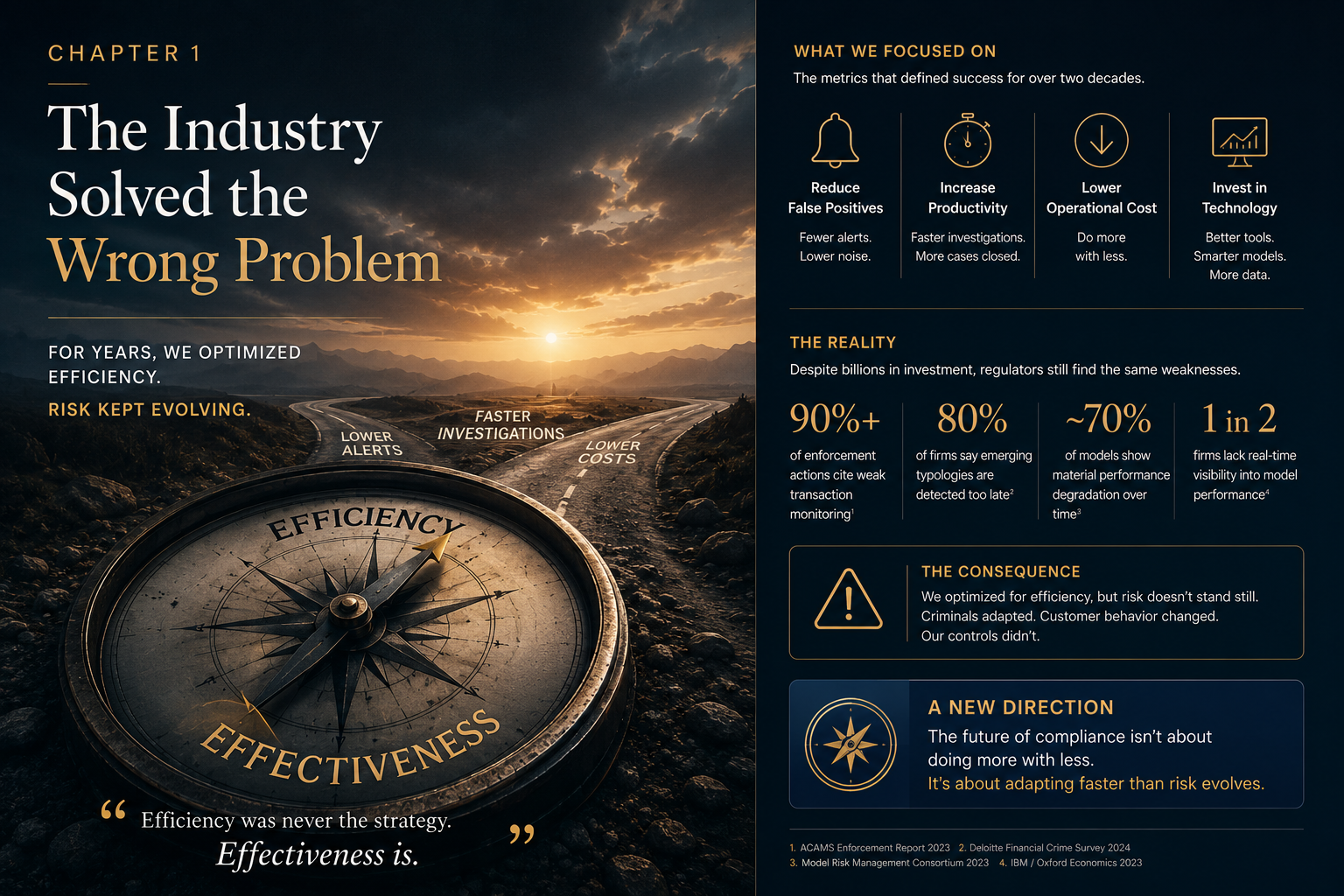
For more than two decades, the financial crime industry has pursued a remarkably consistent objective: improve the efficiency of compliance. Few strategic initiatives have attracted more investment than those designed to reduce false positives, increase investigator productivity and lower the operational cost of financial crime controls.
This focus was understandable. Digital commerce, instant payments and cross-border financial services transformed both the scale and complexity of financial crime risk. Compliance organizations had to process exponentially larger volumes of transactions while operating under greater regulatory scrutiny and continuing pressure to control costs.
The industry responded with remarkable ingenuity. Machine learning reduced unnecessary alerts, workflow automation improved case management, and data science enabled more sophisticated segmentation of customer behavior. Yet enforcement actions continue to identify familiar weaknesses: ineffective transaction monitoring, inadequate customer due diligence, weak governance and failures to adapt controls as criminal methodologies evolve.
Efficiency Is Not the Same as Effectiveness
Efficiency describes how well an organization performs existing activities. It says comparatively little about whether those activities remain appropriate as the world around them changes. A transaction monitoring model may become more efficient at identifying behaviors that are no longer the institution’s highest priority. A sanctions program may operate exactly as designed while geopolitical developments fundamentally alter the institution’s exposure.
In each case, the control functions as intended. The environment simply changed faster than the governance surrounding it.
The Real Challenge Is Adaptation
The institutions that manage financial crime risk most effectively are increasingly those that recognize change earlier, challenge assumptions more rigorously and adapt controls more quickly than their peers. Their advantage lies not only in detecting suspicious activity, but in continuously reassessing whether their understanding of suspicious activity remains current.
The next generation of compliance will not be defined by incremental improvements in operational efficiency alone. Its greatest value will come from helping organizations understand change faster, govern more intelligently and adapt more continuously.