The hardest part of global compliance is not writing a global policy. It is building a process that remains globally governed when the law, evidence, infrastructure and customer reality change from one market to the next.
The false choice between consistency and local relevance
Global institutions are often presented with a false choice.
They can centralize, standardize and control everything from headquarters. Or they can allow local teams to interpret requirements and risk ending up with a collection of country programs that happen to share a logo.
Neither is a serious global operating model.
I have seen what happens when a strong home-market process is exported without examining its assumptions. The policy is translated. The workflow is copied. The same fields become mandatory. The same documents are requested. The same approval path is imposed.
It looks beautifully consistent on a process map.
Then it meets an actual customer.
The document considered ordinary in one country may not exist in another. Ownership may be recorded differently. A reliable registry may be unavailable, structured differently or accessible only in a local language. Payment methods and fraud patterns vary. Regulatory reporting, recordkeeping and data-transfer expectations do not politely align themselves to the global template.
Local teams begin creating workarounds. Operations rely on spreadsheets. Customers are asked for evidence that makes little sense in their market. Exceptions travel to headquarters because the process cannot express a legitimate local answer.
A global process that works only after the local team opens a spreadsheet called FINAL_v7_REALLY_FINAL is not a global process.
The opposite model is no better. If every market designs its own policy, workflow, data definitions and risk language, the institution loses enterprise visibility. Similar customers receive materially different treatment. Local decisions cannot be compared. A control failure in one region teaches the rest of the organization nothing.
The answer is not uniformity or fragmentation. It is a common architecture designed to accommodate governed variation.
Standardize at the right altitude
The phrase “one global standard” is useful only if the standard is defined at the correct level.
Global consistency should apply to the things the institution cannot afford to negotiate market by market:
- the principles behind the control;
- the minimum outcome that must be achieved;
- prohibited customers, products, conduct or practices;
- the core data the institution needs to understand risk;
- the escalation and accountability model; and
- the evidence required to demonstrate that the control worked.
Local variation should apply where regulation and market reality genuinely differ:
- which evidence is legally valid and practically available;
- how legal forms, ownership and authority are established;
- which registries, data sources and languages are used;
- the sequencing of customer questions and disclosures;
- local reporting, retention or data-handling requirements; and
- the risk signals created by local payment behavior and criminal typologies.
This distinction sounds obvious. In practice, many policies mix all of these layers together. A global control objective, a preferred document, a system limitation and somebody’s historical operating habit appear in the same paragraph. Six months later, nobody can remember which part was required by law and which part was required by the software.
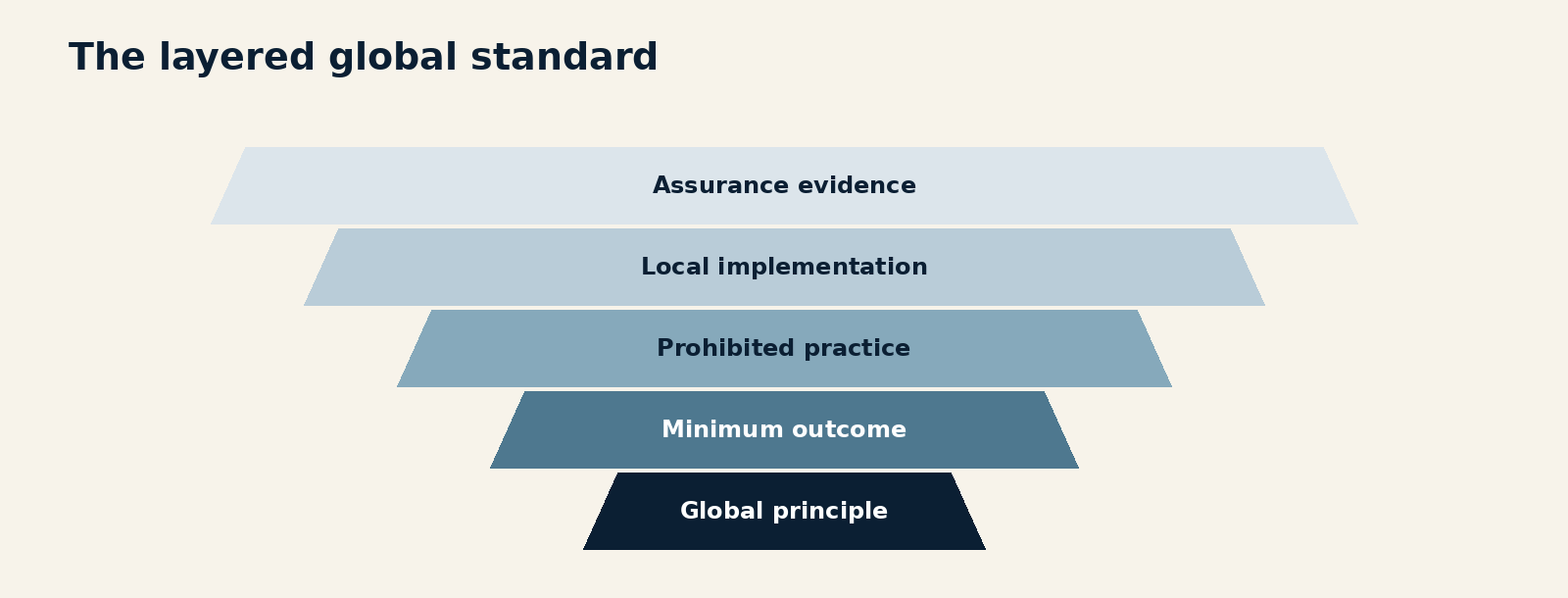
A well-designed standard is layered. It says what must be true, what must never happen, where local interpretation is permitted and what proof must survive. That makes local nuance part of the architecture rather than an apology attached to it.
Build configurable processes, not country clones
Organizations sometimes respond to local complexity by building a separate workflow for every country. That may solve the immediate implementation problem, but it creates another one: every policy change must now be interpreted, coded, tested and deployed dozens of times.
The more scalable approach is one configurable process built from shared components.
A global customer-lifecycle platform, for example, can maintain one core customer and ownership model while allowing the evidence rules, questions, disclosures, review steps and escalation triggers to vary by jurisdiction, legal form, product and risk level.
That requires several capabilities that are less glamorous than the product demo but far more important in production:
- A common data model. The institution needs consistent definitions for the customer, controllers, owners, products, locations, expected activity and risk factors.
- A regulatory-requirements inventory. Local obligations must be traceable to the workflow components that implement them.
- Version-controlled configuration. A local rule should have an owner, rationale, effective date, approval history and testing record.
- Reusable control modules. Identity, ownership, purpose, sanctions, fraud and enhanced-due-diligence capabilities should be assembled, not rebuilt.
- A governed fallback path. When the primary evidence is unavailable, the process should know what alternative evidence can produce equivalent confidence.
This is the difference between localization and customization.
Customization changes the system until one market works. Localization allows the system to express local requirements while preserving the global control architecture.
It also changes how the organization treats exceptions. A repeated exception is not merely an operations problem. It is evidence that the configured pathway does not reflect the market. The correct response may be to change the process—not hire more people to approve the same exception indefinitely.
What the “atlas” should actually map
An atlas is useful here, but not as a directory of countries or a second index of articles. Its purpose is to make the sources of legitimate variation visible.
For every market, product or regulated entity, leaders should be able to locate four coordinates:
Those coordinates turn “local nuance” from a vague reason for inconsistency into a governed design input.
Consider address verification. The global objective may be to establish where a customer resides or operates with an appropriate level of confidence. The locally credible evidence might be a utility bill in one market, government data in another, a tenancy record elsewhere or a combination of digital and contextual checks. The control outcome remains consistent even though the proof does not.
The same logic applies beyond KYC. Transaction-monitoring scenarios should reflect the products, rails and typologies present in the market while feeding a common enterprise risk taxonomy. Regulatory reports may have different formats and deadlines while drawing from governed data. Customer communications can vary by language and legal requirement while the decision and audit trail remain comparable.
The atlas therefore becomes a design discipline: the institution knows where variation exists, why it exists and which part of the global system contains it.
Every variation needs a decision owner
Configuration without decision rights is simply a more sophisticated queue.
Global teams should own the principles, minimum standards, enterprise risk taxonomy, common data, prohibited practices and assurance expectations. Local teams should own interpretation of local legal obligations, regulatory engagement and judgments that depend on market context. Regional teams can aggregate expertise where markets share language, infrastructure, typologies or operating needs.
The important question is not who is most senior. It is who has the information and authority required to make the decision responsibly.
| Decision layer | Typical responsibilities | Evidence of control |
|---|---|---|
| Global | Principles, risk appetite, minimum outcomes, prohibitions, enterprise data and model governance | Policy approval, control taxonomy, common metrics and independent assurance |
| Regional | Shared expertise, calibration, operational coordination and cross-market intelligence | Regional decisions, comparative testing and documented escalation |
| Local | Legal interpretation, regulator-facing requirements, credible evidence and context-dependent judgment | Requirements mapping, local approval and traceable implementation |
Escalation should be reserved for uncertainty, conflict or risk outside the delegated boundary. It should not be the normal route through which every market receives permission to operate.
If every legitimate local answer requires a global exception committee, the organization has not standardized compliance. It has industrialized escalation.
Compare confidence, not paperwork
Governed flexibility works only if assurance can determine whether different local pathways produce an equivalent control outcome.
That means global metrics cannot stop at activity counts. The fact that every market collected a document says very little if the document has different evidential value—or if nobody checked whether it was relevant.
Leaders should compare:
- verification confidence and quality outcomes;
- the rate and cause of manual overrides;
- customer abandonment, rework and approval time;
- exceptions that recur by market or customer type;
- control failures discovered through investigations, testing or regulatory feedback;
- differences in risk outcomes after apparently similar decisions; and
- the time required to translate a regulatory change into a tested process change.
A local pathway that reduces friction but weakens assurance is not good localization. A global pathway that produces excellent paperwork and drives legitimate customers away is not good compliance. The program must see control quality and customer consequence together.
This is also how the system learns. A local workaround becomes a proposed configuration change. A regional pattern becomes an enterprise typology. A regulatory finding becomes a test of whether the same weakness exists elsewhere. Local intelligence should enter the global system faster than the next annual policy review.
What leaders should do next
- Separate outcomes from implementation. Review global policies and identify where a principle, legal obligation, preferred method and system limitation have been mixed together.
- Build the four-coordinate map. For each material market, document the obligation, credible evidence, infrastructure dependencies and decision owner.
- Replace country workflows with governed configuration. Use shared data and reusable controls, with local rules expressed as versioned components.
- Give local experts bounded authority. Define what they can interpret, approve and change without sending routine decisions to headquarters.
- Turn recurring exceptions into design work. Measure them, identify their cause and change the configured pathway where the evidence supports it.
- Test for equivalent confidence. Compare outcomes across markets without demanding identical inputs.
- Create an enterprise learning loop. Make local regulatory developments, control failures and typologies available to the rest of the organization.
One system, intelligently expressed
Global compliance should not mean forcing every market through the same narrow doorway. Nor should local nuance become permission for every team to build its own house.
The goal is one accountable system: common principles, common minimum outcomes, common data and common assurance—expressed through locally credible evidence and clearly owned decisions.
That model is more consistent because it acknowledges reality. It is more scalable because variation is configured rather than improvised. And it is more defensible because the institution can explain not only what differs, but why it differs and how it still satisfies the global standard.
One global standard does not require one global answer.
It requires every answer to meet the same standard of confidence.
Continue the conversation. For speaking, media or advisory enquiries, contact Micheal.