I have lived in America for long enough now that a lot of things which once felt foreign have become completely normal. I say “elevator” instead of “lift” without thinking about it, I understand why Americans consider a three-hour drive a perfectly reasonable way to spend a Saturday, and I have developed a deeply American expectation that every drink should arrive with enough ice to preserve a human organ.
This last one has been a particularly dramatic evolution.
I now love air conditioning. I love excessive air conditioning. I like walking into a building in August and immediately needing a jumper. I have become completely spoiled by it, which means going home to Ireland in the summer and discovering that the hotel room is apparently being cooled by opening the window two inches can now feel like a human rights issue.
The same thing has happened with ice.
Americans do not put ice in drinks so much as they fill a glass with ice and then locate whatever remaining space is available for the beverage. I have fully embraced this. Now I go back to Ireland, order a Diet Coke and receive two lonely ice cubes floating apologetically at the top of the glass.
Two.
At this point I find myself looking at the bartender thinking, “What happened here? Were we rationing?”
This is how assimilation happens, apparently. Not through citizenship or culture, but through developing unreasonable expectations about beverage temperature.

Despite all of that, I am still very Irish.
Even my name tends to announce it before I do. I am Micheal, not Michael, and it is pronounced something much closer to MEEEHALLL. This has caused an extraordinary amount of confusion in America. There is usually a moment when somebody looks at the spelling, looks at me, looks back at the spelling and concludes that either I or my parents have made an administrative error.
For years I have watched people approach it with enormous confidence, only to produce something that sounds like a completely different person. Eventually I learned to intervene early: “It’s Micheal. MEEEHALLL. Irish spelling.”
There is then usually a polite nod followed by “Michael” approximately thirty seconds later.
You get used to it.
There is, however, one inconvenient fact about my Irish identity that I should probably disclose in the interests of transparency.
I was born in England.
There. It is out.
Kettering, specifically.
This is a dark secret I have spent most of my adult life trying to bury under increasingly aggressive references to Dingle. I was raised in Ireland, grew up in Kerry, consider Ireland home, and will happily defend my Irishness in almost any setting, but somewhere in a government archive there is unfortunately documentary evidence that my first appearance on this earth occurred on the wrong side of the Irish Sea.
I appreciate everyone respecting my privacy at this difficult time.
I grew up in Dingle and moved to the United States for work in 2012. Since then I have spent a large part of my adult life moving between Irish, European and American cultures, working with people all over the world, and increasingly I think that living between those cultures has shaped the kind of leader I have become.
Some of it only became obvious after I left.

One of the first things I noticed about America was how comfortable Americans are with ambition. People will simply tell you what they want. They want to run the company. They want the promotion. They want to build a billion-dollar business. They think they could do the job two levels above them and, rather than privately thinking that thought for eleven years, they may actually tell the person currently doing it.
For an Irish person, this can initially be quite alarming.
Ireland has a highly developed cultural mechanism for dealing with anybody who becomes even slightly too impressed with themselves. We call it having notions.
You are allowed to be successful, but you should ideally behave as though the whole thing came as a surprise. You may be ambitious, but it is better if everyone discovers this accidentally. You may even become quite important, provided you retain the good sense to act as if there has been some sort of administrative misunderstanding.
Because no matter how successful you become, Ireland has a way of restoring you to factory settings.
You could become a CEO, ring the opening bell at the New York Stock Exchange, appear on television, receive some prestigious award and fly home feeling, perhaps just briefly, that you have become a significant person.
Then you walk into a pub in Kerry and somebody says:
“Do you remember the school fashion show when you walked out and fell over?”
And suddenly you are twelve again.
This is one of the great national services Ireland provides.
There is no achievement large enough to permanently outrun something embarrassing you did in secondary school.
Somebody remembers.
Usually several people.
And they are generally delighted to tell the story in front of your spouse.
I think there is something profoundly healthy about this.
At the same time, America taught me that our Irish discomfort with ambition can occasionally go too far. There is nothing inherently arrogant about wanting to do something significant. There is nothing embarrassing about wanting the bigger job, building a larger organization, making more money, creating something new or simply saying, “I think I can do this.”
Earlier in my career, I probably believed much more strongly in the theory that if you simply worked hard enough, somebody would eventually notice.
The imagined sequence was that you quietly did excellent work for several years, maintained appropriate levels of humility, and then one afternoon an important person would appear at your desk and say, “Micheal, we have been observing your quiet excellence from afar and would now like to significantly expand your responsibilities and compensation.”
It is a lovely theory.
It is also not really how careers work.
America made me more comfortable saying what I wanted. It made me realize that ambition and humility are not opposites. You can believe you are capable of more without believing you are better than everyone around you. You can want the next job while being grateful for the one you have. You can say, “I think I could build this,” without becoming the kind of person who introduces themselves by mentioning how many people report to them.
That was an important lesson for me.
But if America made me more comfortable with ambition, Ireland gave me something equally valuable: a deep suspicion of anybody who starts taking themselves too seriously.
That instinct becomes particularly useful as you become more senior.
Senior jobs come with some strange psychological hazards. People rearrange their calendars around yours. They prepare presentations specifically for you. Rooms occasionally wait for you before starting. People take notes while you are talking. Somebody may quote back something you said six months ago which you have absolutely no memory of saying.
If you are not careful, this can become extremely bad for the brain.
After enough time, you can accidentally start believing that the reason everyone stopped talking when you entered the room is because everything you are about to say is profoundly interesting.
Sometimes it is simply because you are the boss.
These are not the same thing.
This is why everybody in a senior role needs people in their lives who remain fundamentally unimpressed by them.
Irish families are particularly gifted at providing this service.
You can have what you believe to be an extraordinary professional week, close some enormously complicated issue, give a board presentation, receive praise from senior executives and generally feel that your career is approaching Churchillian levels of significance.
Then you call home.
Nobody asks about any of it.
Instead, somebody wants to know why you have not called your mother, whether you look tired, when you are coming back to Ireland, or if you remember a person whose cousin’s sister you apparently met once in 1997.
Within minutes, your sense of grandeur has been completely recalibrated.
That is healthy.
The more senior I have become, the more I value people who knew me before the title, before the organization became large, before anyone thought my opinions about regulation or financial crime were particularly interesting, and ideally before I knew what I was doing myself.
Those relationships are an antidote to one of the biggest risks of leadership: beginning to confuse your job with your identity.
There is another part of Irishness I miss when I am away, and that is the language.
Irish English is full of phrases that make perfect sense to us and sound completely deranged to everyone else.
Someone can be described as being “as useful as a chocolate teapot,” and everybody knows exactly what you mean.
You can say someone is “as sick as a plane to Lourdes,” and no additional explanation is required.
You can answer a question with “I am, and I amn’t,” which is grammatically questionable, logically contradictory and nevertheless perfectly clear.
And then there is “feck.”
I use “feck” constantly in America because it gives me the emotional satisfaction of swearing while maintaining at least a theoretical degree of deniability.
Americans sometimes hear it and look slightly confused.
“Is that the same as…?”
Not exactly.
But also yes.
It is an extraordinarily flexible word. Someone can be a fecker. Something can be fecked. You can tell someone to feck off with considerably more affection than the English equivalent would allow. It can express irritation, admiration, disbelief or simply fill a gap in a sentence where another culture might use punctuation.
I think language like this matters more than people realize.
It creates intimacy. It carries humor. It says something about a culture that does not always need to state things directly in order to make them perfectly understood.
Irish culture also gave me a fairly acute sensitivity to bullshit.
Large organizations produce extraordinary amounts of language.
We are going to “activate the transformation journey.”
We need to “unlock cross-functional synergies.”
We should “lean into the operating model.”
We are going to “reimagine the paradigm.”
You can sometimes sit through ten minutes of this and realize that absolutely nobody has yet explained what we are actually going to do.
Whenever this happens, there is a small person from Kerry living somewhere inside my head asking a very simple question:
“What the feck does that actually mean?”
I have found this internal voice invaluable.
There is a tendency in business to mistake complexity of language for sophistication of thought, when very often the opposite is true. One of the responsibilities of leadership is to take complicated things and make them understandable.
What are we doing?
Why are we doing it?
Who is responsible?
When does it need to happen?
How will we know if it worked?
Those questions have served me better than almost any management framework.
If we need a slide containing seventeen arrows, six overlapping circles, three acronyms nobody understands and a graphic of a rocket ship before we can explain the strategy, there is at least some possibility that we do not have a strategy yet.
We may simply have PowerPoint.
Irish culture also taught me something about humor that I think is underrated in leadership.
I have spent much of my career working on things that are genuinely serious: compliance, financial crime, sanctions, regulation, risk, situations where getting something wrong has real consequences.
The work matters.
But serious work does not require permanently serious people.
In fact, I think the ability to laugh is often even more important when the work is difficult.
I do not mean organized corporate fun. Nobody has ever received a calendar invitation titled “Mandatory Fun: 4:30–5:30 PM” and thought, “Excellent, exactly what I needed.”
I mean actual humor.
The ability to recognize when something is absurd. The ability to make each other laugh after a terrible day. The freedom to tease people you genuinely like. The ability to walk out of an incredibly intense meeting, look at the person next to you and say, “Well, that went beautifully.”
Some of the best teams I have ever worked with have also been the funniest.
I do not think that is accidental.
Humor builds trust. It lowers the temperature. It reminds people that difficult moments eventually pass. It also prevents everyone from becoming unbearably self-important, which is particularly useful in industries full of impressive titles.
America, meanwhile, gave me something Ireland sometimes struggles with: optimism.
There is a particularly American instinct that things can be built.
A company can become ten times bigger. A person can reinvent themselves. An industry can be changed. You can move somewhere new, start again, take an enormous risk and create a life that looks nothing like the one you started with.
Sometimes this optimism borders on insanity.
I have sat in meetings where an American has described a completely impossible idea with such confidence that, by minute twenty, I have somehow found myself wondering whether we should fund it.
There is something powerful in that.
Europeans sometimes mistake cynicism for intelligence. It is easy to sound sophisticated while explaining why something will never work.
Building it is harder.
America made me much more comfortable asking:
“Why not?”
Ireland usually makes me follow that with:
“Okay, but are we talking complete shite?”
I have found the combination effective.
My American husband may wish to submit a minority opinion on all of this.
I married an American and then, in what may have been a fairly serious breach of the implied terms and conditions, made him live in Dublin for three years.
He therefore has firsthand experience of Irish weather, Irish heating systems, Irish quantities of ice, and being told a seventeen-minute story about somebody he has never met whose aunt apparently went to school with my mother.
In fairness, any account of being Irish in America should probably be accompanied by his version: Being American in Ireland: Three Years of Damp Towels, Two Ice Cubes, and Being Asked If You Know Someone From Boston.
I suspect his cultural exchange involved considerably less air conditioning than mine.
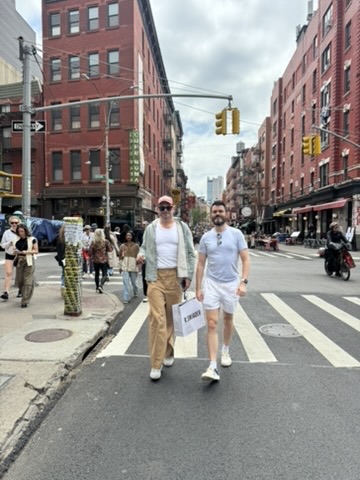
After enough years living between cultures, I am not particularly interested in choosing between them anymore.
There are things about America I love that I never expected to love. I am now firmly pro-air-conditioning, pro-obscene-quantities-of-ice, and frankly suspicious of any establishment that delivers a cold drink containing fewer than eight cubes.
I admire the American optimism, ambition, openness to reinvention and belief in scale.
There are also parts of Ireland I appreciate much more because I left: the humor, the directness, the instinctive suspicion of hierarchy, the importance of community, the expressions, the stories, the ability to take the work seriously without assuming the person doing it must therefore be serious at all times.
And perhaps most importantly, the cultural certainty that nobody should ever get too carried away with themselves.
For a long time I thought living between two cultures meant eventually becoming less connected to one of them.
Instead, I think you get to choose the best parts.
America taught me to be more comfortable with ambition, to say what I want, to think bigger and to believe that enormous things can actually be built.
Ireland taught me to keep perspective, to ask simple questions, to laugh when things get ridiculous, to treat people normally regardless of their title and to maintain a highly functioning bullshit detector.
America taught me to believe I might be able to do something extraordinary.
Ireland taught me that, if I ever start describing myself as extraordinary, somebody should immediately remind me of the school fashion show, tell me to cop myself on, and ask why I am acting the fecking eejit.
I am pretty happy with that combination.
And if I ever forget where I came from, I have an Irish name nobody in America can pronounce, an entire town in Kerry capable of correcting my ego, a growing dependency on American quantities of ice, and, regrettably, a British birth certificate sitting somewhere as documentary evidence of my darkest secret.
Explore more: Leadership & Identity or Being Funny at Work Wasn’t Always About Being Funny.